Edge Cloud
- What is Edge Cloud
- How does it differ from a classic cloud solution
- Advantages of Edge Cloud
- How cloud solutions help businesses
- Cloud architecture
- What to do when computing resources are scarce
- Cloud computing services
- Adapting computing to application tasks
- For which industries cloud solutions are suitable
- Cloud security and resiliency
- Problems and limitations of edge cloud computing
- Where cloud deployment unfolds better
Edge Cloud is a software and hardware package that is hosted on the client's premises and provides all the advantages of a cloud infrastructure without transferring data to remote servers. In other words, this is a "cloud in a box" - a rack of equipment that is installed in your data center or office, and which is as capable as a public cloud, but at the same time completely under your control.
Why spend money on hardware if the provider has a cloud?
The answer is simple - response speed, data security, and predictable costs, from architecture and configuration options to tariffs, industry cases, and typical questions that are asked before a purchase.
When compared with the usual rental of cloud capacity from a provider, the difference is felt already at the stage of setting the task. In the classic Cloud, you pay for what is outside your infrastructure and depend on the quality of the connection to the data center.
As a result, you get physical hardware that becomes part of your own infrastructure, but It is managed as conveniently as the cloud, using the usual virtualization and orchestration tools.
What is Edge Cloud and how does it differ from the classic solution?
Edge Cloud is a new paradigm in IT that shifts data processing closer to where it originated. Instead of driving traffic to and from the provider's data center, calculations take place right "on the edge" of the network - where the data is generated: in production, at a retail outlet, in the company's data center.
| Parameter | Classic cloud | Edge cloud |
|---|---|---|
| Resource location | Provider's remote data center | Client's territory |
| Response time | Depends on the communication channel | Minimal, local processing |
| Control | Partial | Full |
| Equipment ownership | No, rental | Yes, equipment ownership |
| Payment model | Monthly subscription | Capital costs |
| Scaling | Fast, by the provider | Requires a physical upgrade |

Advantages of Edge Cloud
- Instant response time. On-site data processing eliminates delays associated with the transfer of traffic to and from the data center. This is very important for manufacturing, retail, video surveillance systems and any scenarios where every millisecond is important.
- Safety. Information does not leave the company's borders, which means that the risks of leakage during transmission are reduced, and compliance with regulatory requirements for information storage is simplified.
- Saving resources. Due to local processing, the load on external communication channels is reduced, and some of the information can be filtered and aggregated on site, sending only what is really needed to external storage.
How Edge Cloud Helps Businesses
In addition to the technical advantages, technology directly affects business performance:
- It improves the user experience - applications respond faster, which is very important for retail, games and media.
- It allows you to monetize metrics - local analysis opens up the possibility to quickly turn raw data into analytics and products based on it.
- Improves system reliability - less dependence on an external communication channel means less downtime.
Architecture: what's inside the "box"
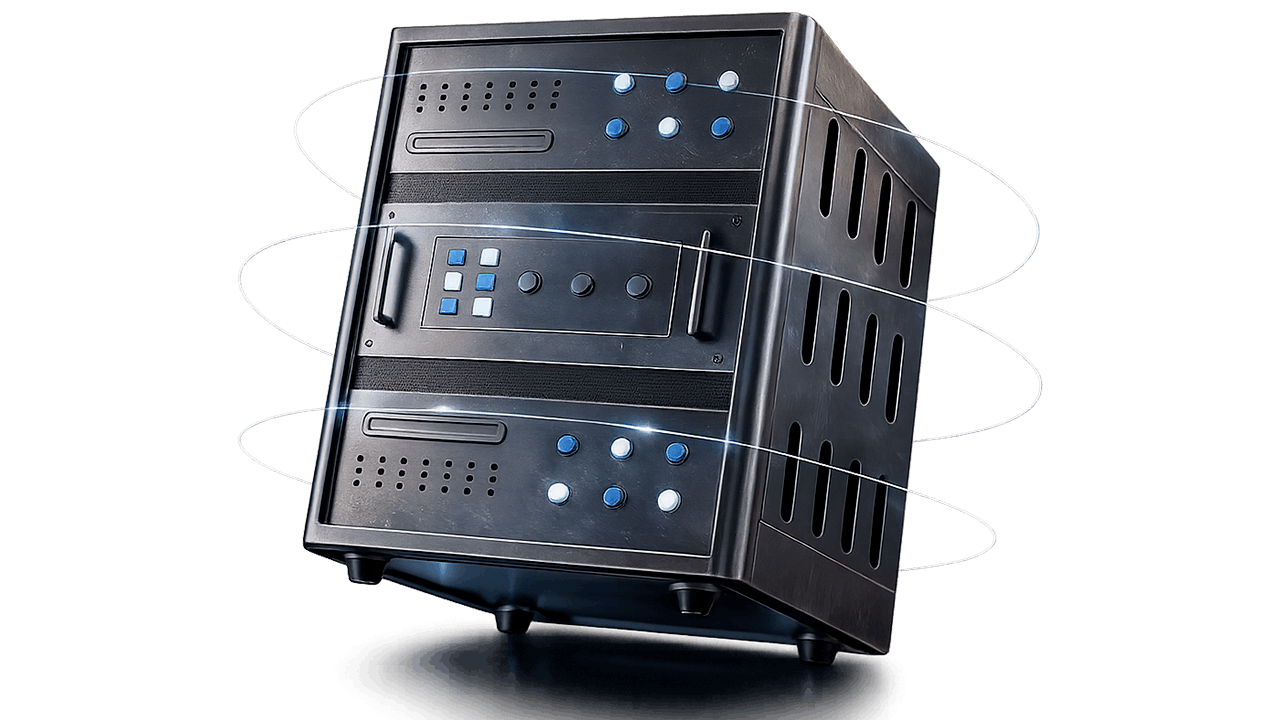
Architecture is built from the same components as any serious data center, only in a compact form factor:
- Computing servers and storage systems - provide computing power and data storage.
- Virtualization system - allows you to flexibly share resources between virtual machines.
- FC (Fibre Channel) switches - provide fast and reliable information exchange between nodes.
The standard PACK fits into a rack of 48 units and includes the following features:
| Component | Characteristic |
|---|---|
| Processor type | Enterprise-class server CPUs |
| Processor frequency | Is load-adjustable |
| RAM | Scalable, from basic configuration to maximum |
| Storage capacity | Flexibly increased |
| Performance | Depends on the type of tasks (1C, virtualization, analytics) |
| Network options | Various connection schemes, including FC |

What should I do when computing resources start to run out?.
There are two ways:
- Upgrade - adding CPU, RAM or storage to an existing complex without replacing the entire system.
- Cabinet replacement - if the load has increased dramatically, a more powerful rack is installed, designed for a larger number of equipment - up to 80 units.
Adaptation to applied tasks
It can be customized to suit the specifics of a particular business. For example, for companies operating in 1C, the complex adapts so as to provide a Gilev test score of 60+ points - this is an important performance benchmark for accounting systems. This flexibility applies not only to 1C, but also to other application workloads: analytics, databases, video monitoring.

Cloud Computing Services
The solution is not just hardware, but a full-fledged cloud platform with a familiar set of services:
- Virtual machines are the basic building block for any workload.
- Load balancers - distribute traffic between nodes for fault tolerance.
- Bare metal - dedicated physical platforms for demanding tasks without a virtualization layer.
- Managed Kubernetes is a managed container orchestrator for modern applications.
Which industries are such cloud solutions suitable for?
Cloud solutions are already used by more than 350 customers from a wide variety of fields:
| Branch | Typical usage scenario |
|---|---|
| Online retail | Real-time transaction processing |
| Education | Local learning platforms and storage of student information |
| Games | Delay reduction for multi-user servers |
| Media | Analysis and streaming of content without delays |
| Financial technologies | Fast transaction processing taking into account information retention requirements |
| SaaS | Hosting of own services on the client's infrastructure |

Security and fault tolerance
The conversion of indicators at the network edge reduces the risks associated with the transfer of information to external data centers, but requires a careful approach to protecting the most peripheral special equipment.
We recommend combining:
- Built-in security features at the package level.
- Redundancy of key nodes (power supply, network, storage).
- Regular monitoring of the condition of special equipment and timely maintenance.

Challenges and Limitations of Edge Cloud Computing
Difficulties that may be encountered:
- Physical maintenance of special equipment - unlike public Cloud, part of the responsibility for hardware falls on the customer or requires on-site service.
- Scaling limitations - capacity growth requires upgrades or replacement of special equipment, not just a few taps in the control panel.
- Distributed management - if a company has several sites with a Cloud solution, you need a single monitoring and management system for all nodes.
These difficulties can be solved if you think about the service model in advance and include backup components in the project.

Where cloud deployment reveals itself best: application scenarios
There are several technological areas where the use of edge cloud computing is becoming almost an alternative option:
- Internet of Things (IoT). Sensors and devices generate huge amounts of information, and it is unprofitable to transfer all this to a remote data center - it is expensive over a communication channel and slow in response time. The architecture processes and sorts information on-site, sending only aggregated results to the off-site storage.
- Telecommunications. When using cloud edge computing to process traffic closer to the subscriber, telecom operators reduce the load on backbone networks and make services work faster.
- The automotive industry. Autopilot and telematics systems require real-time processing - a split-second delay is very critical here, so calculations are carried out as close as possible to the vehicle or road infrastructure.
- Smart cities. Video surveillance, traffic management, and environmental monitoring all create a constant flow of information that is more efficiently processed locally rather than sent to central data centers.
Demand for the service will grow with the growth of IoT, 5G networks, and real-time data processing requirements. The trend towards hybrid structures: classical and boundary structures do not compete, but complement each other.
Heavy analytics and long-term storage remain in the central data center, while real-time processing and sensitive information remain on the edge of the network closer to the customer. Companies that build such a hybrid model in advance gain an advantage both in the speed of services and in cost control.
Conclusion
Edge Cloud is a smart choice for companies that need fast conversion, infrastructure control, and predictable long-term costs. It does not replace the public cloud completely, but adds it where low latency and local storage of information are critical.