Private Cloud: Architecture, benefits, and when it's really justified

Private Cloud - is a separate cloud infrastructure created for a single company, with full control over resources, security, and management rules.
Unlike the public model, where resources are shared among many clients, here computing power, network and storage are allocated logically or physically for one customer.
You rent or host your own infrastructure, but use it as a cloud.:
- virtual machines,
- scaling,
- automation,
- API access,
- self-service panel.
That is, it is not just a server — based, but a full-fledged cloud platform with resource management.
How Private Cloud works
The basis of a private cloud consists of three main parts:
Virtualization
- Hypervisors (KVM, VMware, and others) divide physical servers into virtual resources.
The management system
The management platform (for example, OpenStack or VMware vCloud) controls:
- creating a VM,
- network,
- storage,
- access roles.
Automation and orchestration
DevOps tools allow you to:
- deploy infrastructure according to templates,
- automate updates,
- manage scaling.

| Type | Where it is located | Suitable for whom | Features |
|---|---|---|---|
| Local (On-Premises) | At the customer's office | Big business | Maximum control, high CAPEX |
| Managed Private Cloud | In the provider's data center | Medium and large businesses | The balance of control and outsourcing |
| Virtual Private Cloud (VPC) | Inside a public cloud | Projects with increased requirements | Logical isolation |
An important point. A VPC is not a full—fledged physical private cloud. This is a virtual segment within a public platform.
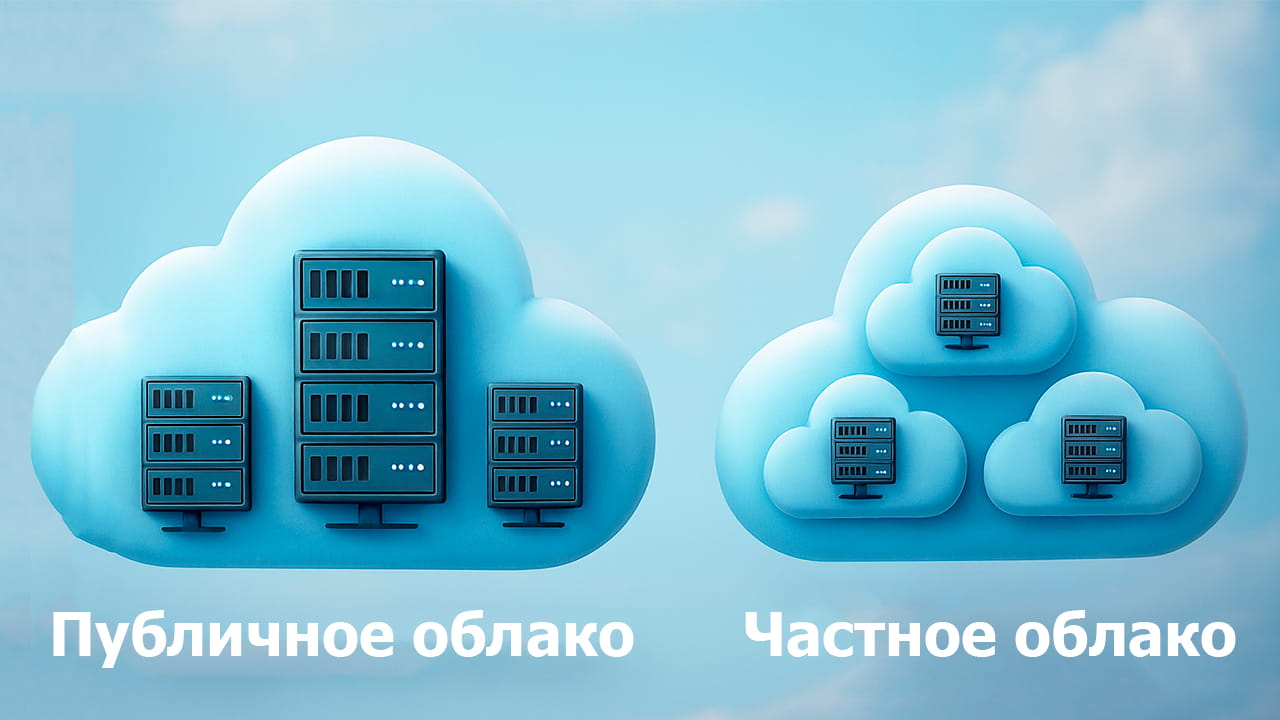
The essence of the difference is control and isolation.
| Criteria | Public | Private |
|---|---|---|
| Control | Limited | Full |
| Safety | General Infrastructure | Isolated |
| Scalability | Almost unlimited | Depends on the architecture |
| Entrance fee | Low | High |
| Customization | Limited | Full |
Which is safer?
With proper configuration, both options are safe. But a private cloud wins if:
- strict regulatory requirements,
- sensitive personal data,
- banking or government infrastructure.

Improved security and control
- Full network segmentation
- The ability to implement your own security policies
- Access control at the hypervisor level
- Isolation from other clients
Individual settings
Can:
- choose a storage architecture (SAN/NVMe/CEPH),
- configure network policies,
- implement non-standard firewall rules,
- integrate with internal AD/LDAP.
Scalability
Resources are being added:
- horizontally (new nodes),
- vertically (expansion of existing servers).
Important: scalability requires proper design at the start.
Performance optimization
- Dedicated CPUs
- NVMe storage
- 10-25-40 Gbps Network
- Minimum delays
I'll be honest — they are.
- High initial costs (CAPEX).
- A competent architecture is required.
- The complexity of administration.
- Payback begins with stable or high load.
If you have a startup with unpredictable traffic, the public option may be more logical.

Who really needs a private cloud
The financial sector:
- Cans
- Payment systems
- FinTech
Healthcare:
- Storage of medical data
- HIPAA/Regulatory requirements
Government organizations:
- Critical infrastructure
- Personal data of citizens
The manufacturing sector:
- ERP systems
- SCADA
- High predictable load
The basic architecture includes:
- Cluster of computing nodes
- Fault-tolerant storage
- Network factory (L2/L3 segmentation)
- Load balancers
- Backup system
- Monitoring and logging
The design of a private cloud takes into account:
- N+1 on nutrition
- N+1 by computing nodes
- RAID / distributed storage clusters
- Georeservation (if necessary)
If everything is done correctly, the SLA reaches 99.95—99.99%.
Consulting and design
We are analyzing:
- the load,
- peak values,
- fault tolerance requirements,
- safety requirements.
Implementation and migration
The process includes:
- audit of the current infrastructure,
- migration plan without downtime,
- the test environment,
- phased transfer.
Automation
They are being implemented:
- CI/CD,
- Infrastructure as Code,
- automatic backups,
- scaling.
Safety
- network segmentation,
- WAF,
- IDS/IPS,
- data encryption,
- regular security audits.
Technical support
Critical for production:
- 24/7 monitoring,
- SLA,
- responding according to the regulations,
- backup scenarios.

Depends on the load. Example:
| Load | Which is more profitable |
|---|---|
| Unstable, startup | Public space |
| Stable average | Depends on the model |
| High constant | Private space |
Usually, payback occurs after 12-24 months with a constant load.
I recommend:
- Centralized monitoring (Zabbix, Prometheus).
- Regular security audits.
- Scaling planning.
- Automation of routine tasks.
- Documentation of the architecture.
Without this, the whole structure turns into an expensive set of servers.
Choose it if:
- There are regulatory requirements.
- Strict isolation is needed.
- The load is stable and high.
- A custom architecture is required.
- Full data oversight is important.
Если же проект:
- growing fast,
- It has no strict requirements,
- testing the business model,
— it is more reasonable to start with a public model and migrate later.
With the right structure, it is as reliable as possible.
Reliability is ensured by:
- Network segmentation.
- Dedicated firewalls.
- Role-level access monitoring.
- Data encryption (at rest and in transit).
- Logging and SIEM.
- Regular audits.
But it is important to understand that "private" in itself is not equal to "reliable". Without proper configuration, the risks remain.
Usually in cases of:
- Significant consistent performance.
- Long-term projects (2+ years).
- Critical business services.
- Significant cost of downtime.
If productivity is unstable or seasonal, it is often cheaper.
Depends on the scale:
- A small cluster lasts 2-4 weeks.
- The average corporate project lasts 1-3 months.
- With georeferencing and complex migration, it takes longer.
Most of the time is spent not on installing servers, but on:
- designing,
- testing,
- safe migration.
It is possible, but with reservations. Expansion options:
- Adding nodes to the cluster.
- Storage expansion.
- Updating the network structure.
However, this requires:
- planning,
- budget,
- availability of equipment.
In the public version, scaling is faster, but without full tracking.
Yes, if everything is planned correctly. Used:
- data replication,
- parallel technology,
- staged migration,
- a test run.
A complete "seamless" transfer is possible, but requires a preliminary audit.
Yes.
Despite the growth of services, they remain in demand in:
- the financial sector,
- the public sector,
- industry,
- large corporate IT environments.
The trend of recent years is hybrid models:
Core core + community resources for scaling.
There are three models:
- A completely internal team.
- Managed model (Managed Private Cloud).
- Hybrid scheme (part on the customer's side, part on the provider's side).
For most companies, the second option is optimal — it reduces operational risks and does not require maintaining a large team of specialists.

Private Cloud — it's not about "fashionable". It's about monitoring, predictability, and security. It is justified where:
- downtime is unacceptable,
- The information is critical,
The main thing is to design the structure of a private cloud correctly from the very beginning. Otherwise, you will get an expensive design without cloud advantages.
If you approach it professionally, this solution becomes a stable foundation for a serious business.